Oct26
How Boston Scientific Accelerates Innovation
Point: Capture, share and reuse knowledge to make R&D engineers more productive
Story:
At Power to Innovate 2009, Boston Scientific’s Randy Schiestl (VP of R&D) and Jude Currier (Cardiovascular Knowledge Management & Innovation Practices Lead) described how Boston Scientific is redesigning its innovation processes. 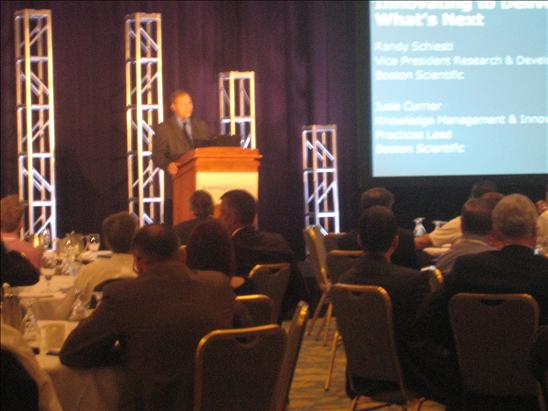 The goal: to accelerate time to market, increase the productivity of innovators, and reduce costs and risks.
Boston Scientific is an $8 billion company committed to delivering innovative medical technologies that improve the quality of patient care as well as healthcare productivity. The company has a broad portfolio of 13,000 products. The new products in its pipeline include drug coated stents, bare metal stents, catheter and bio-absorbable technology.
In the past, Boston Scientific drove innovation from business strategy to technology development to product development. In this staged approach, engineers created technology-driven products that were then shown to business units and customers at the prototype stage. The trouble with this process was that the later groups often found gaps or risks in the proposed product late in the product development process. As a result, the company had to spend more money than expected putting out fires while trying to hold to a launch schedule. Boston Scientific decided to change its innovation process to bring more knowledge and resources into the earlier stages of innovation.
As part of the new innovation process, Boston Scientific began bringing in key “voices” into the innovation process earlier. By getting these voices — the voice of the customer, the voice of the business unit, and the voice of regulatory bodies — earlier, the company uncovered its knowledge gaps and risks much sooner. The second part of Boston Scientific’s innovation process redesign gave employees access and pointers to relevant information, whether that information resided in a document or in the tacit knowledge of an expert. The goal here was to reduce the amount of time engineers spend looking for knowledge. Schiestl said engineers spend 30% of their time looking for relavant knowledge. To improve upon that, Boston Scientific used Goldfire (innovation software from Invention Machine) to capture, share and reuse knowledge. Goldfire’s semantic technology automatically categorizes concepts can and ties relevant intelligence to specific innovation initiatives. For example, engineers used Goldfire to identify past research and then validate whether that research could be repurposed. The result: Boston Scientific engineers who used Goldfire spent only 10 percent of their time researching intelligence, compared to 20-30 percent by non-Goldfire users.
Boston Scientific’s new innovation process illustrates what Mark Atkins, CEO of Invention Machine, called an innovation intelligence ecosystem. This ecosystem represents the aggregate of information, communities, and processes that collectively contribute to innovation. Here’s how it works: using innovation software like Invention Machine’s Goldfire, companies capture and reuse information and intellectual capital created by employees as well as by external sources. Goldfire further enables collaboration by accurately reconstructing a user’s past thinking and research process, making it visible and explicit to other users. Employees avoid reinventing or duplicating research already done, thus saving time and improving innovation productivity.
Boston Scientific shared two examples of its success using Goldfire and the company’s new innovation processes. First, the company improved the design of cardiac stents to reduce a patient’s injury-response to the device. By combining knowledge from across the innovation ecosystem, the company mapped key clinical knowledge about heart disease and how different heart artery conditions affect the patient outcomes with different stent designs.
In the second example, Boston Scientific used Goldfire to solve a technical problem in manufacturing that was reducing product yields. Using Goldfire, Boston Scientific found that previously undocumented thermocapillary effects were leading to clogged spray nozzles. By understanding the physics of the cause, Boston Scientific was able to make a simple change to the manufacturing line to eliminate the clogging and thereby improve yields.
Action:
- Uncover all the “voices” that have a say in the success of innovations (the voice of the customer, voice of technologists, voice of manufacturing, voice of regulatory compliance, etc.). Connect key people and communities in a more collaborative, sharing-oriented environment
- Identify, organize, and access information (internal and external) needed by these communities to do their innovation-related work.
- Develop knowledge and innovation processes that find and resolve knowledge gaps or risks early in the innovation process.
Comments Off on How Boston Scientific Accelerates InnovationCase study, How-to, Innovation, New Product Development, Productivity, R&D, Software tool, Strategy

 My second time at KOOZA, I sat in the second row, so I had a closer look at the costumes. Even from the very last row (where I sat the first time), I remember the dazzling shine of the juggler’s suit. The second time, I had a chance to see the intricacy of all the costumes, which led me to wonder about the R&D that must go into them. The costumes hug tight body lines yet flex with all the contortions the performers make.
 new company that helps retailers understand patterns of behavior at store locations. Many retailers have security cameras on site, but they rarely look at the data generated by those cameras because of the sheer volume of data. The raw data is typically viewed only in the event of a robbery. Retel, however, developed a cost-effective human-aided video data analysis service that extracts workplace performance analytics from all that unused video footage. For example, the system can help spot problems such as dirty tables at fast-food locations, employee theft, and capacity bottlenecks (such as a shortage of cashiers during certain hours). Retel provides its clients monthly reports to help managers see trends, behaviors, and time-of-day patterns that can help them better manage their stores.
 social media to help band managers. The music industry is undergoing big changes, but sales of concert tickets are the highest they’ve been in ten years, and people are buying more music than ever. Giving band managers data can help them make better decisions. For example, real-time data from Twitter can be captured and analyzed to show who’s talking about which band and where they are — data that can provide great insight into a band’s fan base. Next Big Sound collects a host of both social media and web data to provide real-time marketing analytics that bands can use in variety of ways. For example, band managers can use the data to pinpoint the demographics of fans, scout new concert locations, and improve online ad placement. They can even suggest that a band mention people or events in the local area or give a shout-out to high-profile fans at a concert.