Mar11
Andrea Meyer
Point: Use publicly-available photos to shed light on tourist delight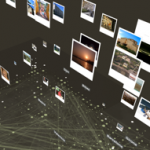
Story: Barcelona invested heavily to revamp the city to attract tourists for the Olympics and beyond. What places did tourists visit? What did they see and like? What did they tell their friends about? The city can measure tourism dollars, but the intangible experience of pleasure is harder to measure.
The Los Ojos Del Mundo (The World’s Eyes) project helps provide some answers. The project looks at the publicly-available photos on Flickr that people post of Spain. Using data mining and visualization techniques, team members from MIT’s SENSEable city lab plotted photos onto a map of Spain. The concentration of photos shows which places tourists deem most photoworthy and want to share with their friends.
Action: Consider what data is publicly available on your product, brand, or city. Flickr, Twitter and blogs are all rich sources of user-generated photos, opinions or reviews. Analyze which features or aspects of your product are displayed or mentioned. This data helps reveal how customers portray, experience or feel about your product.
For more information: See Los ojos del mundo (the world’s eyes) for full information on the project as well as additional photos, courtesy of http://senseable.mit.edu/worldseyes/press.html
Girardin, F., Calabrese, F., Dal Fiore, F., Ratti, C., and Blat, J. (2008). Digital footprinting: Uncovering tourists with user-generated content. IEEE Pervasive Computing, 7(4):36-43.
Girardin, F., Dal Fiore, F., Ratti, C., and Blat, J. (2008). Leveraging explicitly disclosed location information to understand tourist dynamics: A case study. Journal of Location-Based Services, 2, 1, 41-54.
For more on creative design and the field of information visualization: Information Aesthetics
Customers, How-to, Innovation, Metrics
Mar06
Andrea Meyer
Point: Enlist hobbyists for mutual benefit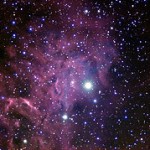
Story: Every night, hundreds of amateur astronomers photograph the night sky. Some have joined the Astronometry group on Flickr to upload and share their photos with others. The Astronometry.net project created an algorithm that helps identify the celestial objects in the photo. Hobbyists who submit their photos get a clear identification of what they photographed. In turn, the automated astronometry project adds to its storehouse of knowledge of planets, galaxies and other space phenomena. Currently, the project is calculating the path that comet Holmes took through the sky.
This project shows that the average person can still make a contribution to astronomical science, without having high-powered equipment. “There’s a large number of excellent amateur setups out there, and they discover supernovae and minor planets regularly,” said project team member Christopher Stumm of Microsoft in an interview, “We believe that if the information generated by the amateur astronomer community is harnessed, we could build an open-source sky survey much faster.”
Action: Find a group of enthusiasts in your field of interest. Use social media tools they likely already use (like Flickr). Give them a benefit to participate in your project – it could be a direct benefit (like identification their photo) and or a broader benefit, like satisfaction of participating in the advancement of science.
For more information, see: Found in Space

Lulin Composite photo by Richie Jarvis - UK
How-to, Innovation, Opportunity
Mar04
Andrea Meyer
Point: Business and communities can create a talent-attracting virtuous circle
Story: McKinsey & Co. partnered with the World Economic Forum to evaluate what makes a given region an “innovation hub.” McKinsey analyzed 700 variables and summarized the results in “Building an Innovation Nation.” Despite the report’s title, the principles apply to business and city regions as well.
The single common factor that drives innovation across all sectors is the availability of a well-qualified talent pool. Talent attracts talent, creating a reinforcing success cycle.
Let’s look at Boulder, Colorado to see these principles in action. Boulder is #1 in the nation for software engineers per capita. The tech community thrives largely due to the efforts of volunteers who organize regular meetings that let technologists find & talk with each other. Here are five examples. First, Rob Reich’s Boulder Denver New Tech monthly meet-ups are among the largest, attracting upwards of 350 technologists and entrepreneurs. The meetings feature presentations by new and emerging tech companies, who describe their business models and demo their software/products. Brian Tsuchiya’s Startup Entrepreneurs is another monthly meet-up, giving very early-stage entrepreneurs a chance to practice their pitch to a smaller audience and get feedback on their pitch & plan. Andrew Hyde’s Ignite Boulder events bring the community together in lighthearted events that are then livestreamed and archived. His Startup Weekend began in Boulder and is now in dozens of cities. Jeremy Tanner organizes unconferences like PodCamp Boulder. TechStars provides seed funding, office space to mingle and mentors from whom to learn. Local venture capitalists like The Foundry Group are active in sharing their insights through Boulder Open Coffees, presentations at Silicon Flatirons and mixers like StartUp Drinks. Local businesses like PR firm Metzger Associates are regular sponsors of many events. At all of these events, companies looking to hire and candidates looking for jobs can announce their presence.
Action: Help specialists in your community find each other through mixers and events. Create public calendars (such as Andrew Hyde’s Boulder.Me) to let everyone know about upcoming events. Share highlights of past events to give newcomers a flavor of them (see Rocky Radar and w3w3 Talk Radio). Participate in these events to find potential new hires and new business opportunities. Emphasize the resource-matching and idea cross-pollination opportunities of these events.
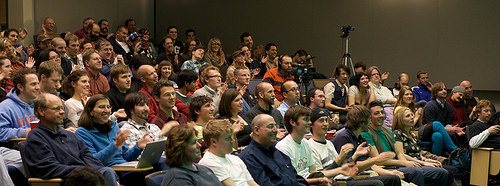
Ignite Boulder Feb 2009 by Stepan Mazurov
Entrepreneurs, How-to, Innovation, Opportunity